Planets and Solar Systems: Exploring Worlds Beyond Our Own
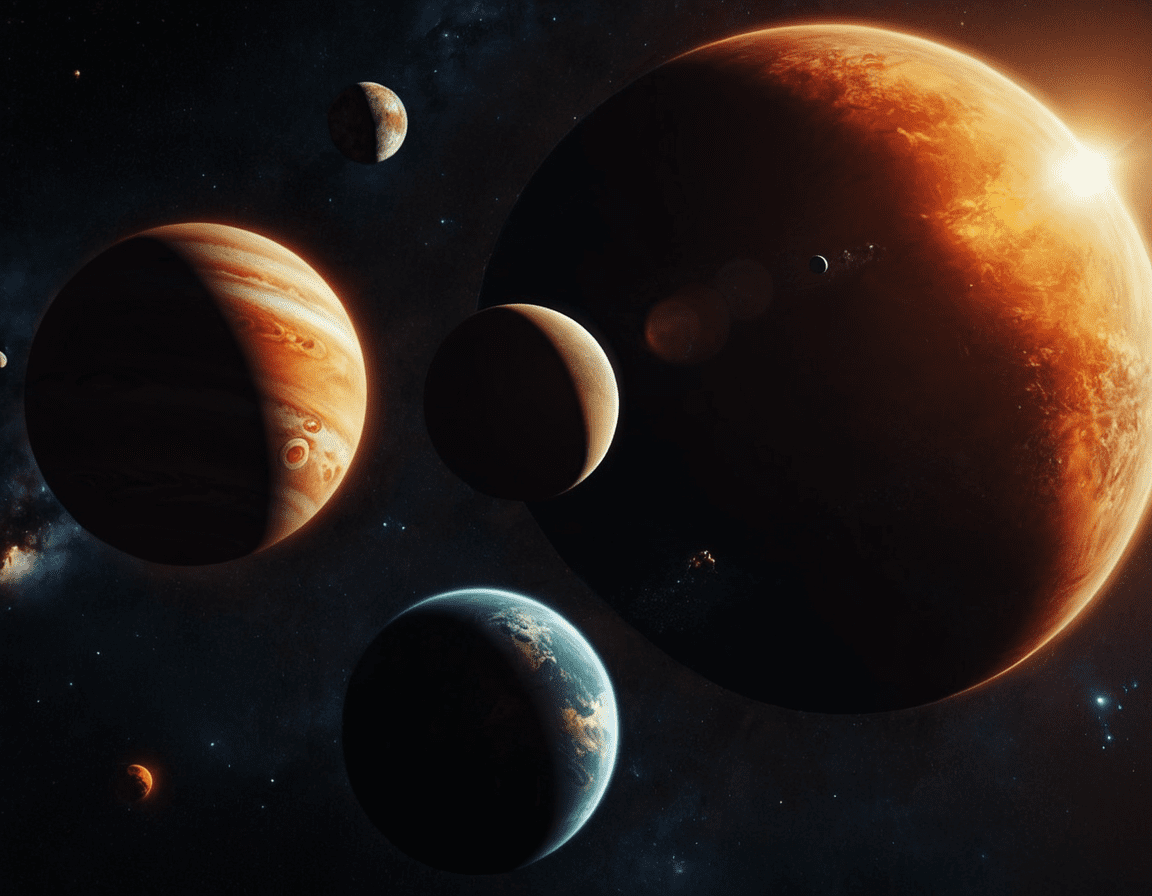
The universe is a vast and mysterious space filled with galaxies, stars, and countless planets. Among the most fascinating topics in astronomy are planets and solar systems, fundamental units that help us understand the formation and evolution of the universe.
The Birth of Solar Systems
A solar system is a collection of celestial bodies that orbit around a star. Our Solar System, with the Sun at its center, is just one of the billions of solar systems present in the Milky Way. The formation of a solar system begins with a nebula, a vast cloud of gas and dust. Under the influence of gravity, this cloud collapses, forming a protostar at the center. The remaining material flattens into a circumstellar disk, where dust particles agglomerate to form planetesimals, the building blocks of future planets.
The Planets of Our Solar System
Our Solar System includes eight main planets, each with unique characteristics:
Mercury: The closest planet to the Sun, with extreme temperatures and a cratered surface similar to the Moon's.
Venus: Known for its dense carbon dioxide atmosphere and sulfuric acid clouds, Venus has an extremely high surface temperature.
Earth: The only known planet that harbors life, with a surface rich in water and an atmosphere that protects from harmful space effects.
Mars: Often called the "red planet" due to its iron oxide-rich soil, Mars is a primary target in the search for extraterrestrial life.
Jupiter: The gas giant, the largest planet in the Solar System, known for its Great Red Spot, a giant storm.
Saturn: Famous for its spectacular rings made of ice and dust.
Uranus: A gas giant with an extreme axial tilt, making it appear as if it rolls on its side.
Neptune: Known for its strong winds and blue atmosphere, rich in methane.
Extrasolar Planets
Astronomers have discovered thousands of extrasolar planets, or exoplanets, orbiting around other stars in our galaxy. These planets vary greatly in size, composition, and distance from their parent star. The discovery of exoplanets is primarily achieved through two methods:
Transit Method: When a planet passes in front of its parent star, it causes a temporary dip in the star's brightness. This method has led to the discovery of thousands of exoplanets, thanks to space missions like Kepler and TESS.
Radial Velocity Method: By measuring the variations in the star's velocity caused by the gravitational pull of an orbiting planet, astronomers can infer the presence of an exoplanet.
The Search for Life
One of the most intriguing questions in astronomy is whether life exists beyond Earth. Scientists search for exoplanets in the "habitable zone" of their stars, where conditions might allow the presence of liquid water. Missions like the James Webb Space Telescope are designed to study the atmospheres of exoplanets and search for signs of life.
Evolving Solar Systems
Solar systems are dynamic and constantly evolving. Impacts from asteroids and comets, gravitational interactions between planets, and planetary migration can radically change the configuration of a solar system. Studying solar systems at different stages of their evolution helps astronomers better understand the past and future of our own Solar System.
Future Missions
Future space missions promise to deepen our understanding of planets and solar systems. Projects like NASA's Europa Clipper aim to explore the icy moons of Jupiter, which might harbor subsurface oceans and potentially forms of life. Other missions aim to bring back samples from Mars and study exoplanets more closely.
In conclusion, the study of planets and solar systems not only helps us better understand our place in the universe but also fuels our desire to explore and discover. Every new discovery opens a window to distant and mysterious worlds, bringing us closer to answering fundamental questions about life and the origin of the cosmos.